Amazon Is a Compliance Platform First, Marketplace Second
Why Amazon Account Health Rating Determines Survival for U.S. Sellers
Most Amazon sellers believe growth comes from ads, keyword ranking, and conversion rate optimization.
That belief is incomplete.
Amazon is a compliance-driven ecosystem first, and only then a marketplace.
Your Amazon account health rating determines whether you are allowed to sell. Revenue, visibility, and growth only happen when Amazon’s system classifies your account as low-risk.
This is where most U.S. sellers misunderstand the platform.
They optimize listings.
They increase ad spend.
They scale inventory.
But they ignore the operational metrics that truly control their future.
The Reality: Compliance Is Amazon’s Risk Filter
Amazon protects customer trust at all costs. To do this, the platform constantly evaluates:
- Order defect rate
- Amazon’s valid tracking rate
- Amazon’s late shipment rate
- Customer complaints
- Policy adherence
- Delivery performance
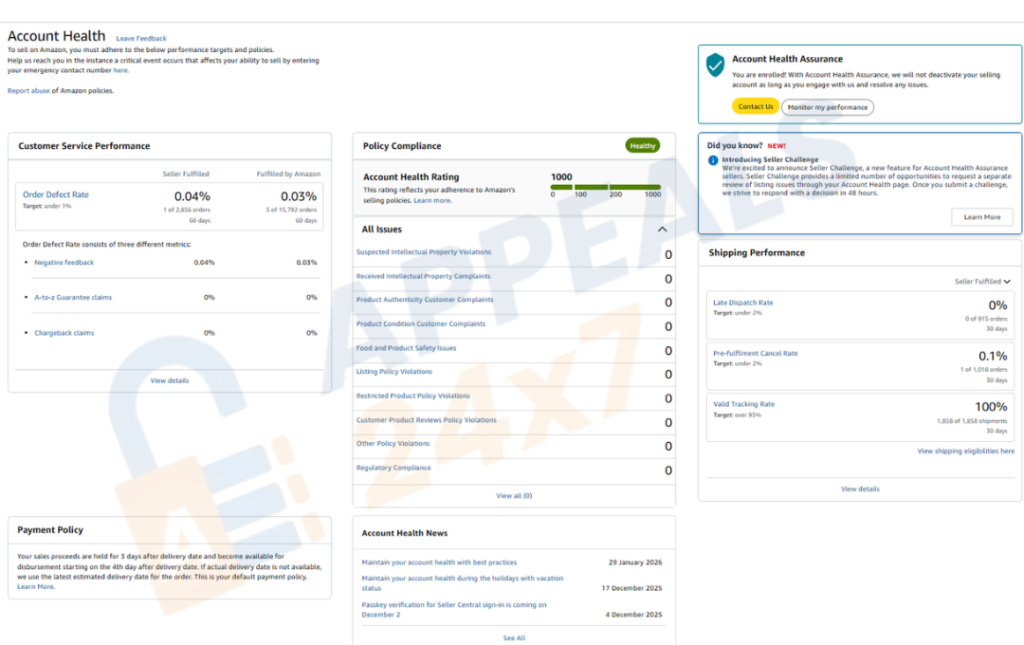
Your Amazon account health rating is a real-time compliance scorecard.
When this score weakens, enforcement risk increases.
When it drops significantly, Amazon account suspension becomes a probability – not a possibility.
Understanding Amazon Account Health Rating
Amazon’s Account Health dashboard measures your adherence to:
- Product authenticity
- Customer satisfaction
- Fulfillment standards
- Listing compliance
- Regulatory requirements
Even if your revenue is strong, compliance weaknesses can override performance.
The sellers who understand this build systems around Amazon account health best practices instead of reacting to violations.
The Three Compliance Metrics That Control Suspension Risk
1. Order Defect Rate Optimization
Order Defect Rate (ODR) includes:
- Negative feedback
- A-to-Z Guarantee claims
- Chargebacks
Amazon’s threshold is under 1%.
However, serious sellers aim much lower.
Effective order defect rate optimization requires:
- Immediate negative feedback monitoring
- Fast refund or resolution protocol
- Carrier performance tracking
- Proactive customer communication
Many suspensions begin with slow response systems – not product problems.
2. Amazon Valid Tracking Rate
The Amazon valid tracking rate is one of the most overlooked performance metrics.
Tracking accuracy tells Amazon:
“Is this seller operationally reliable?”
Low tracking rates indicate fulfillment instability.
To maintain compliance:
- Upload tracking immediately
- Use Amazon-approved carriers
- Ensure carrier scan verification
- Automate shipment data sync
U.S. sellers who maintain tracking rates above 98% rarely face shipping-based enforcement.
3. Amazon Late Shipment Rate
The Amazon late shipment rate measures handling discipline.
Even small increases can damage your Amazon account health rating.
Common causes include:
- Unrealistic handling times
- Weekend workflow gaps
- Staffing inconsistencies
- Inventory misalignment
To prevent escalation:
- Adjust processing cutoffs
- Implement daily shipping audits
- Maintain backup fulfillment options
Compliance discipline is an operational discipline.
How to Prevent an Amazon Seller Suspension
Many sellers ask:
“How to prevent an Amazon seller suspension?”
The answer is simple but uncomfortable:
Prevention requires structure.
Not reactive appeals.
Not emotional explanations.
Not last-minute corrections.
True prevention includes:
- Weekly account health review
- Monthly compliance audit
- Immediate policy alert response
- Root cause documentation
- Internal compliance checklist
When you adopt a formal Amazon compliance checklist for sellers, enforcement becomes predictable – not surprising.
The Compliance Gap Most Sellers Ignore
Most sellers focus on:
- Ads (ACoS, TACoS)
- Keyword ranking
- Conversion rate
- Revenue velocity
But Amazon evaluates:
- Risk
- Customer trust
- Policy adherence
- Operational maturity
This is why two sellers with identical revenue can have completely different enforcement risk.
Amazon rewards stability.
A U.S. Seller Example: Compliance Before Crisis
A mid-sized U.S. seller recently approached after noticing:
- Rising late shipment rate
- Slight ODR increase
- Valid tracking inconsistencies
No suspension had occurred yet.
But their Amazon account health rating was trending downward.
Instead of waiting for enforcement, the seller implemented:
- Structured order defect rate optimization
- Automated tracking integration
- Handling time recalibration
- Weekly compliance audits
Within 60 days:
- ODR stabilized well below threshold
- Valid tracking rate exceeded 98%
- Late shipment rate reduced to a safe range
- Account health returned to green
The result?
Revenue increased 22% – not from ads, but from stability.
Compliance unlocked performance.
Amazon Account Health Best Practices for Long-Term Stability
If you are serious about building a resilient U.S. Amazon business, implement these:
- Monitor the Amazon account health rating weekly
- Keep Order Defect Rate under 0.5%
- Maintain Amazon’s valid tracking rate above 95%
- Keep the late shipment rate under 2%
- Respond to buyer messages within 24 hours
- Maintain documentation for all operational workflows
- Conduct quarterly compliance stress testing
This is how mature sellers operate.
Why Amazon Prioritizes Compliance Over Growth
Amazon’s goal is simple:
- Protect the customer.
- Every metric is designed to measure seller reliability.
- When reliability declines, enforcement follows.
- When reliability strengthens, visibility improves.
- The Buy Box favors stability.
- Search ranking favors consistency.
- Account health favors discipline.
Final Truth: Growth Follows Compliance
If your Amazon account health rating is weak, scaling ads will not save you.
If your compliance foundation is unstable, revenue is temporary.
Amazon is a compliance platform first, marketplace second.
Sellers who understand this:
- Avoid suspension
- Maintain Buy Box stability
- Improve long-term ranking
- Build scalable systems
Sellers who ignore compliance operate in permanent risk mode.