
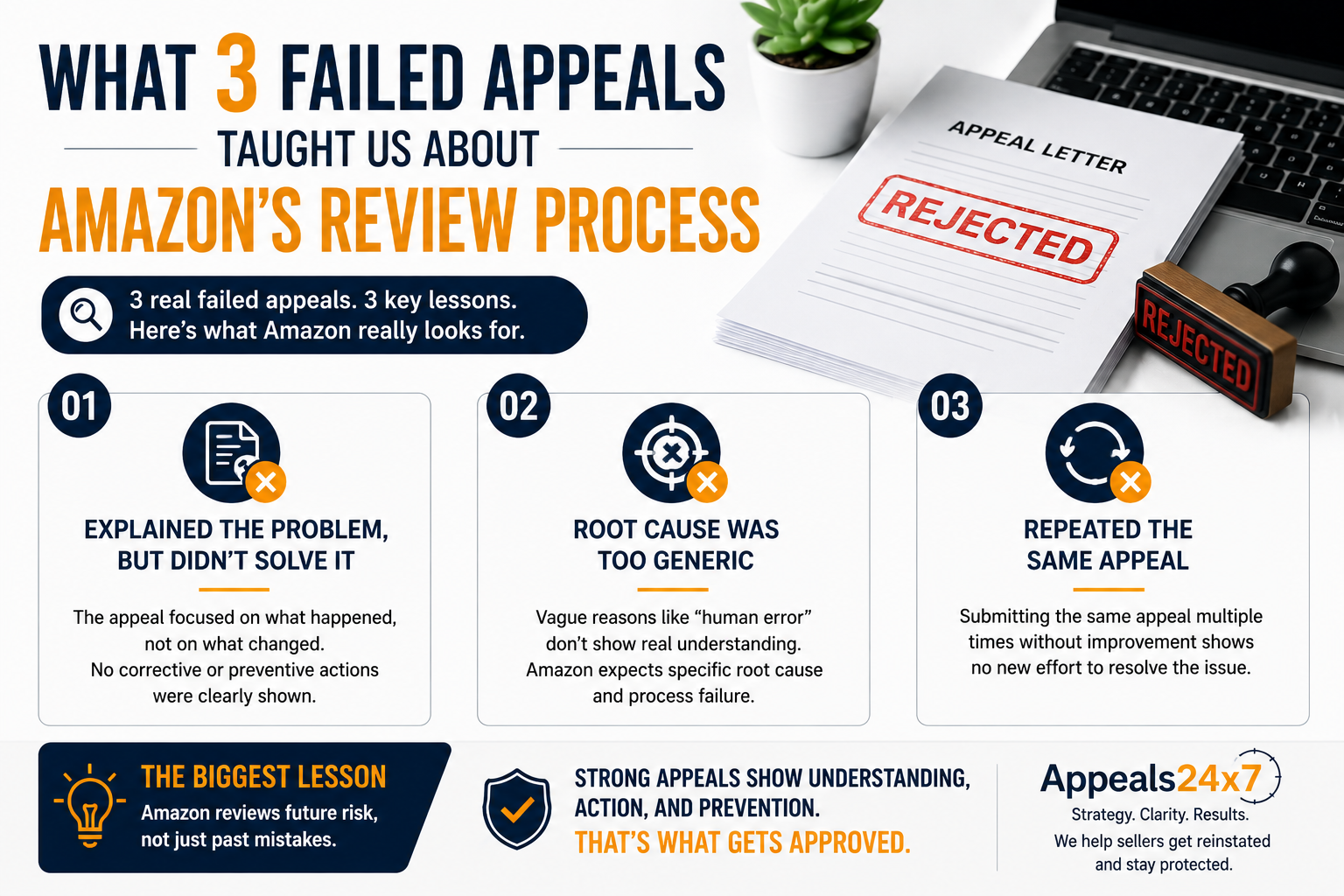
What 3 Failed Appeals Taught Us About Amazon’s Review Process
Most Amazon sellers assume that appeal rejections are random.
One reviewer approves.
Another rejects.
Different outcomes. Different decisions.
But after reviewing multiple failed appeals, one thing becomes clear:
Amazon’s review process is more predictable than most sellers realize.
The problem is not randomness.
The problem is that most appeals fail to answer the questions Amazon is actually evaluating.
At Appeals24x7, we’ve seen this pattern repeatedly across reinstatement cases.
And three failed appeals revealed something important:
- Amazon doesn’t focus only on the issue
- It focuses on the seller’s ability to control future risk
That changes everything.
Failed Appeal #1 – The Appeal Explained the Problem, But Didn’t Solve It
The first seller submitted a detailed explanation:
- Supplier delays
- Inventory confusion
- Customer complaints
The appeal was long. Professional. Well-written.
And still rejected.
Why?
Because the appeal focused on:
❌ What happened
But Amazon was evaluating:
✅ What changed
There were no:
- Implemented corrective actions
- Preventive systems
- Operational improvements
The seller explained the issue.
But Amazon didn’t gain confidence that the issue wouldn’t happen again.
Failed Appeal #2 – The Root Cause Was Too Generic
The second seller identified the issue as:
“Human error.”
That’s one of the most common reasons appeals fail.
Because “human error” is not a root cause.
It’s a symptom.
Amazon expects sellers to identify:
- Which process failed
- Why were controls missing
- How operational gaps were corrected
Without specificity, the appeal lacked credibility.
Failed Appeal #3 – The Seller Repeated the Same Appeal
The third seller submitted nearly identical appeals multiple times.
Only small wording changes were made.
The result?
Repeated rejection.
Why?
Because Amazon saw:
- No new investigation
- No updated preventive action
- No meaningful operational change
Repetition without improvement signals unresolved risk.
An unresolved risk is exactly what Amazon tries to avoid.
What These Appeals Revealed About Amazon’s Review Process
These three cases exposed a clear pattern.
Amazon reviews appeals through three core questions:
1. Does the Seller Understand the Real Issue?
Surface-level explanations are not enough.
Amazon looks for:
- Operational understanding
- Root cause clarity
- System-level awareness
2. Has the Risk Been Removed?
Promises are weak.
Amazon wants evidence that:
- Corrective actions are already implemented
- Systems are already updated
3. Can This Problem Happen Again?
This is the most important question.
Because Amazon evaluates:
Future risk – not just past mistakes.
The Biggest Misunderstanding About Amazon Appeals
Most sellers think appeals are about:
- Apologies
- Explanations
- Defending the account
But Amazon’s review process is actually about:
- Risk reduction
- Operational control
- Long-term trust
That’s why emotionally written appeals often fail.
And structured, evidence-based appeals perform better.
What Strong Appeals Do Differently
Successful appeals usually include:
✅ Clear Root Cause
Not vague statements.
Specific operational failures.
✅ Corrective Actions Already Implemented
Not future intentions.
Completed improvements.
✅ Preventive Measures
Long-term systems that reduce future risk.
✅ Concise Structure
Clear, direct, and focused.
Not overly emotional or defensive.
What We’ve Seen at Appeals24x7
Across multiple reinstatement cases, one pattern consistently appears:
Appeals fail when sellers focus on explaining the past instead of controlling the future.
The strongest appeals are not necessarily the longest.
They are the clearest.
And clarity builds trust.
Related Insight
Many sellers continue submitting the same appeal repeatedly without identifying the real operational issue. Understanding why repeated appeals fail can help prevent longer suspension cycles and additional rejection.
Final Thought
Amazon’s review process is not random.
It’s structured around risk evaluation.
And the sellers who succeed are usually the ones who understand one thing early:
Amazon is not asking for a better explanation.
It’s asking for a better system.
Leave A Comment