
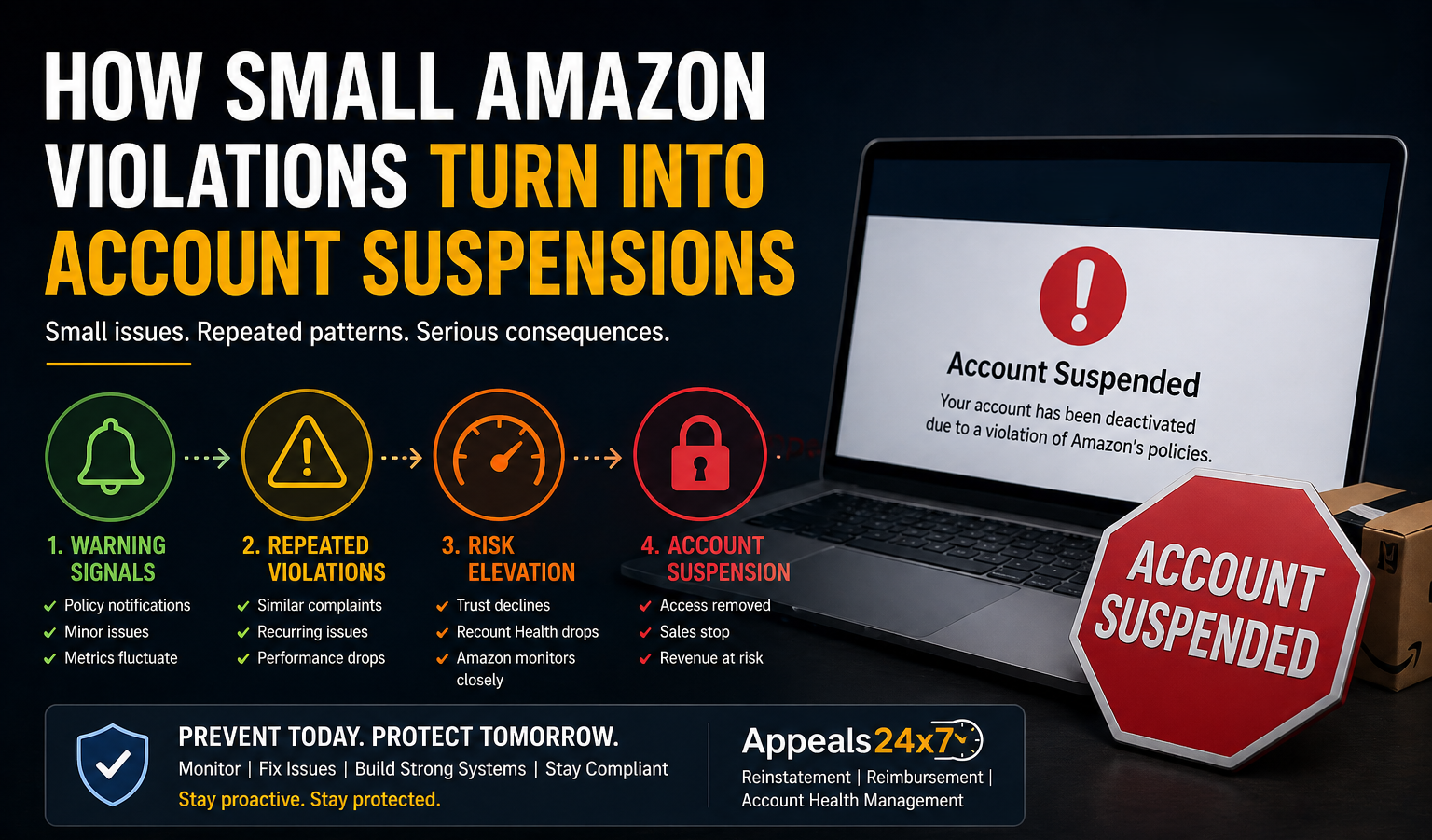
How Small Amazon Violations Turn Into Account Suspensions
Amazon account suspension rarely happens overnight.
It builds.
Slowly. Quietly. Often invisibly.
What starts as a minor issue – a late shipment, a product complaint, a policy warning – can escalate into something far more serious.
Amazon doesn’t suspend accounts for a single mistake.
It suspends accounts because of patterns.
And most sellers don’t recognize those patterns until it’s too late.
The Hidden Escalation Behind Amazon Violations
Most sellers treat violations as isolated events:
- A single customer complaint
- A delayed shipment
- A listing warning
But Amazon doesn’t evaluate events individually.
It evaluates risk over time.
Every issue contributes to a broader picture:
- Reliability
- Compliance
- Customer experience
And when that picture starts to show inconsistencies, risk increases.
The 4 Stages of Amazon Violation Escalation
Understanding this progression is critical for preventing suspension.
Stage 1 – Warning Signals
At this stage:
- Policy notifications appear
- Account health metrics fluctuate
- Minor issues are flagged
Most sellers ignore this phase.
Because nothing “serious” has happened yet.
Stage 2 – Repeated Violations
Now patterns begin forming:
- Multiple similar complaints
- Recurring fulfillment issues
- Listing inconsistencies
This is where Amazon starts paying closer attention.
Stage 3 – Account Risk Elevation
At this point:
- Account health declines
- Performance metrics weaken
- Trust signals drop
Amazon now sees your account as potentially risky.
Stage 4 – Account Suspension
This is not sudden.
It’s the result of:
- Unresolved issues
- Repeated patterns
- Lack of preventive action
By the time suspension happens, the warning signs are already there.
Why Sellers Miss the Warning Signs
Most U.S.-based sellers focus on:
- Sales
- PPC
- Growth
But overlook:
- Account health signals
- Compliance risks
- Policy changes
The problem isn’t a lack of effort.
It’s misdirected attention.
The Real Issue – System Failure, Not Single Mistakes
Here’s the shift most sellers need to make:
❌ “We had a problem with one order.”
✅ “Our process allowed that problem to happen.”
Amazon doesn’t evaluate what happened once.
It evaluates:
Whether your system allows it to happen again.
How to Stop Violations Before They Escalate
1. Monitor Account Health Proactively
Don’t wait for warnings.
Track:
- Order defect rate
- Late shipment rate
- Customer complaints
Related:
The real risk often starts long before suspension. Many sellers overlook the hidden cost of ignoring Amazon account health – until it directly impacts their account.
2. Fix Root Causes Immediately
Don’t patch issues.
Fix:
- Supplier inconsistencies
- Quality control gaps
- Listing inaccuracies
3. Build Preventive Systems
Strong sellers don’t react.
They implement:
- SOPs for quality checks
- Supplier verification processes
- Ongoing monitoring systems
4. Take Early Warnings Seriously
A warning is not a notification.
It’s a signal.
Ignoring it increases risk exponentially.
What We’ve Seen at Appeals24x7
Across multiple cases, one pattern is clear.
Sellers rarely get suspended for a single major mistake.
They get suspended because:
- Small issues repeat
- Signals are ignored
- Systems are weak
At Appeals24x7, we’ve helped sellers move from risk to recovery by identifying these patterns early and correcting them before escalation.
When to Take Action
If you’re noticing:
- Repeated warnings
- Declining account health
- Policy-related notifications
Don’t wait for suspension.
Or if already suspended:
Consider a structured approach to Amazon account reinstatement that focuses on root cause, corrective action, and long-term prevention.
Final Thought
Amazon doesn’t escalate problems randomly.
It responds to patterns.
And the difference between a warning and a suspension is often just time and inaction.
Small violations don’t stay small.
They either get fixed – or they grow.
Leave A Comment