Amazon Invoice Requirements: What Documents Amazon Actually Accepts
For many Amazon sellers, receiving an invoice request can be stressful.
Whether Amazon is conducting an account review, investigating product authenticity, verifying a supplier, or reviewing a listing, one thing is clear: the documents you submit can directly impact the outcome.
Unfortunately, many sellers assume that any purchase receipt or supplier document will satisfy Amazon’s requirements. In reality, Amazon follows strict invoice verification standards, and documents that appear legitimate to a seller may still be rejected.
Understanding Amazon invoice requirements is essential for protecting your account, maintaining compliance, and avoiding unnecessary suspension risks.
Why Amazon Requests Invoices
Amazon’s primary objective is customer trust.
When Amazon requests invoices, it is usually trying to verify one or more of the following:
- Product authenticity
- Supply chain legitimacy
- Inventory sourcing
- Brand authorization
- Product safety compliance
- Seller account verification
Amazon wants evidence that products are being sourced from legitimate suppliers and that sellers can demonstrate a reliable supply chain.
If the documentation does not meet Amazon’s standards, the account or listing may remain restricted until acceptable evidence is provided.
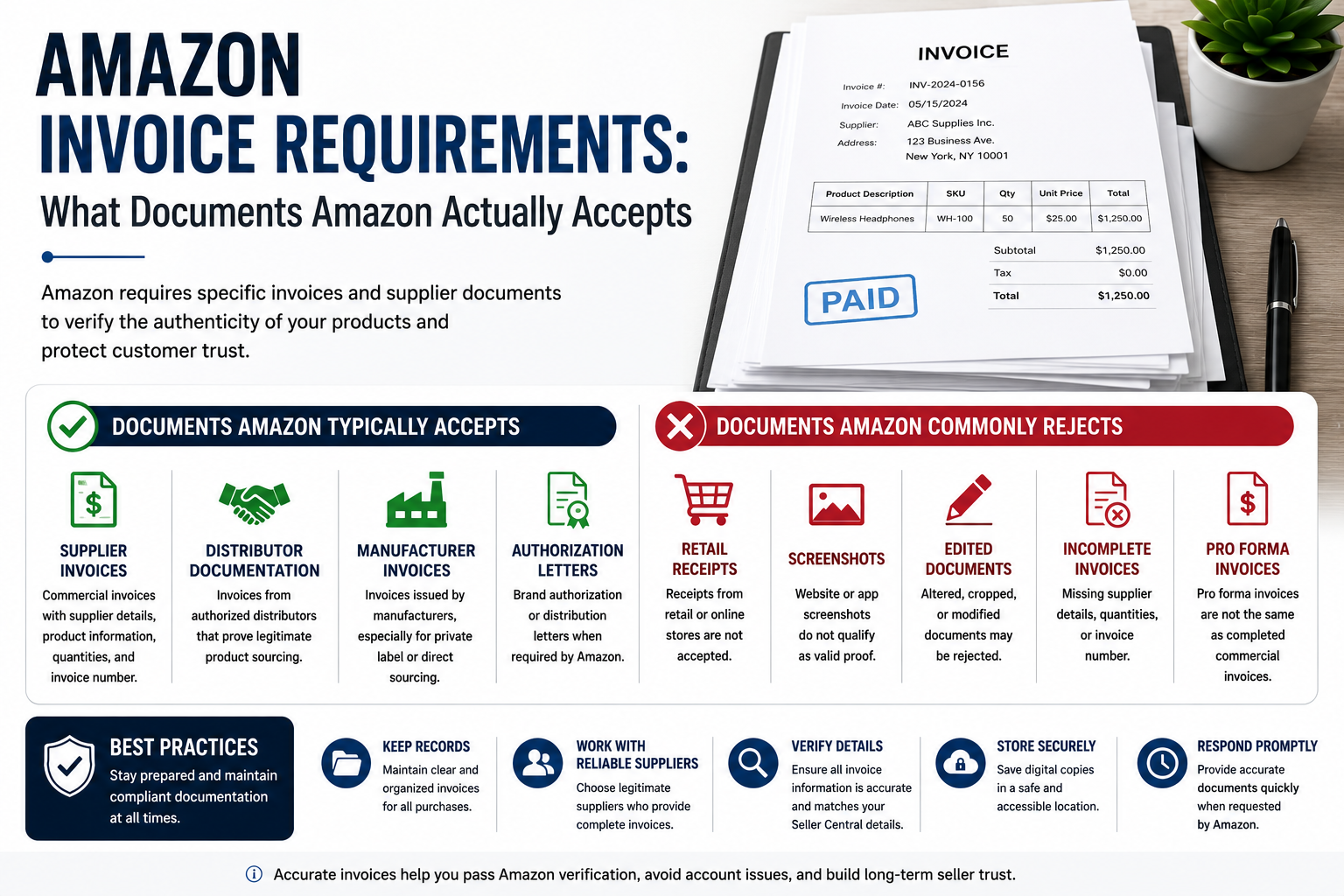
What Documents Amazon Typically Accepts
Many sellers confuse invoices with receipts.
Amazon generally prefers commercial supplier invoices rather than retail receipts.
Accepted documents often include:
Supplier Invoices
Supplier invoices remain the most commonly requested documents.
A valid invoice typically contains:
- Supplier business name
- Supplier address
- Supplier contact information
- Invoice number
- Invoice date
- Product descriptions
- Purchase quantities
- Buyer information
The information should be clearly visible and easy to verify.
Distributor Documentation
If products are sourced through an authorized distributor, Amazon may accept distributor-issued invoices that establish the product’s supply chain.
The distributor should be a legitimate business capable of verifying product sourcing if Amazon requests additional information.
Manufacturer Documentation
For private-label brands or direct manufacturer relationships, manufacturer-issued invoices often satisfy verification requirements.
These documents should clearly connect the seller to the source of the products.
Authorization Letters
In some situations, Amazon may request authorization documentation in addition to invoices.
This commonly occurs for branded products and restricted categories.
Documents Amazon Commonly Rejects
One of the biggest mistakes sellers make is submitting documents that Amazon does not consider sufficient proof of sourcing.
Examples include:
Retail Store Receipts
Purchases made from retail stores are frequently rejected because they do not demonstrate a commercial supply chain.
Screenshots
Screenshots from websites, marketplaces, or supplier portals rarely meet Amazon’s documentation requirements.
Edited Documents
Any document that appears to have been modified, altered, cropped, or manipulated may raise compliance concerns.
Incomplete Invoices
Missing supplier details, missing quantities, or missing contact information can result in rejection.
Pro Forma Invoices
A pro forma invoice is not the same as a completed commercial invoice and may not satisfy Amazon’s verification requirements.
Common Amazon Invoice Verification Mistakes
Many sellers submit invoices believing they have provided everything Amazon requested.
However, invoice rejection often occurs because of avoidable errors.
Mismatched Business Information
The seller information on the invoice should align with the information registered in Seller Central whenever possible.
Discrepancies can create additional verification challenges.
Insufficient Product Quantities
Amazon often expects invoices to demonstrate a reasonable quantity of purchased inventory.
Very small quantities may raise questions regarding sourcing practices.
Poor Document Quality
Blurry scans, incomplete pages, or low-resolution files can prevent successful verification.
Always provide clear, high-quality copies.
Missing Supply Chain Transparency
Amazon increasingly evaluates supply chain legitimacy.
If the source of inventory cannot be clearly identified, additional documentation may be required.
Why Invoice Compliance Matters
Invoice requests are not simply administrative tasks.
They often play a significant role in:
- Amazon seller account verification
- Product authenticity reviews
- Intellectual property investigations
- Account health assessments
- Amazon account reinstatement efforts
A strong documentation process can significantly reduce risk and improve response times during compliance reviews.
Best Practices for Amazon Sellers
To stay prepared for future verification requests, sellers should maintain organized documentation systems.
Consider these best practices:
Maintain Digital Records
Store invoices securely and organize them by supplier and product category.
Vet Suppliers Carefully
Work only with reputable suppliers that can provide complete commercial invoices.
Verify Invoice Details
Review all invoices before submission to ensure accuracy and completeness.
Keep Long-Term Documentation
Amazon may request historical documentation months after products were purchased.
Maintaining organized records helps prevent delays.
Respond Promptly
When Amazon requests documentation, timely and accurate responses can improve the review process.
How Invoice Issues Can Affect Account Reinstatement
For suspended sellers, invoice verification often becomes a critical part of the reinstatement process.
If Amazon believes products cannot be properly sourced or authenticated, account recovery may become more complicated.
In these situations, sellers frequently need to demonstrate:
- Legitimate sourcing
- Supplier credibility
- Inventory traceability
- Corrective actions
- Preventive measures
Strong documentation can strengthen a reinstatement strategy and help address Amazon’s concerns.
Final Thoughts
Amazon invoice requirements are designed to protect marketplace integrity and customer trust.
Unfortunately, many sellers discover documentation problems only after Amazon requests verification.
The best approach is proactive preparation.
By maintaining complete supplier invoices, verifying sourcing documentation, and ensuring compliance with Amazon’s standards, sellers can reduce risk and navigate verification requests more confidently.
When it comes to Amazon document verification, preparation is often the difference between a smooth review process and a prolonged account issue.
For sellers facing invoice-related verification challenges, investing time in documentation accuracy today can prevent major disruptions tomorrow.
Leave A Comment